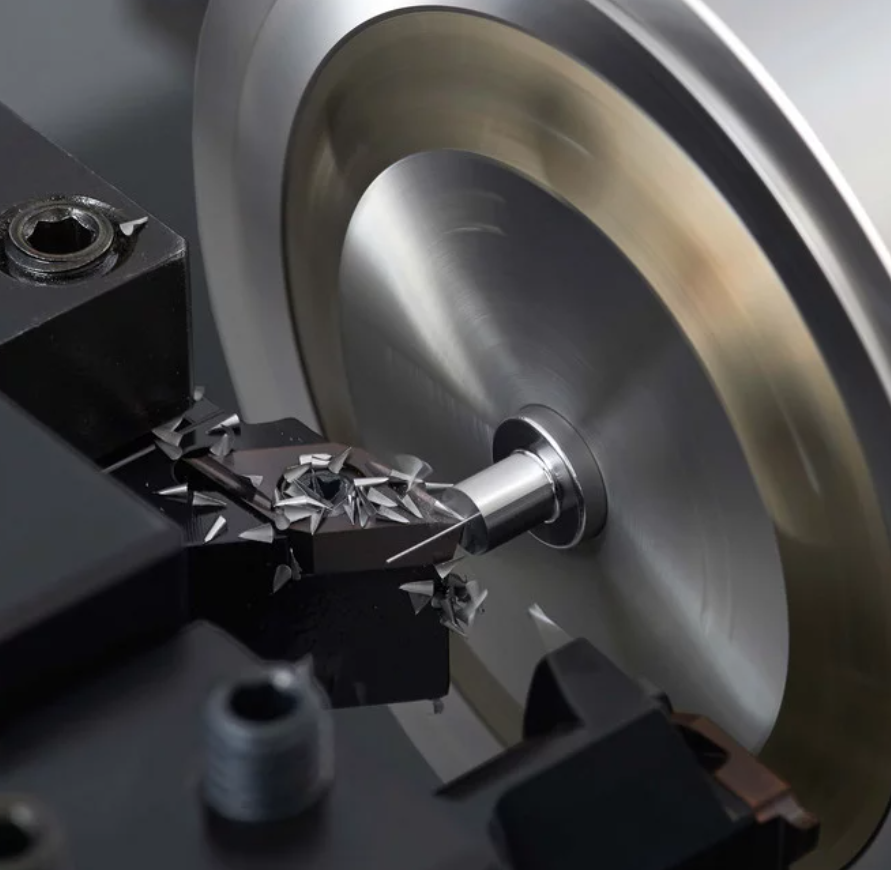
In CNC machining, LFV stands for low-frequency vibration. It is a controlled cutting technique that oscillates a feed axis in synchronization with spindle rotation to deliberately break chips. Particularly associated with Citizen’s Cincom and Miyano turning machines, LFV uses programmed tool motion to interrupt chip formation instead of relying only on an insert’s chipbreaker.
How LFV Works
In conventional turning, the tool advances continuously, which can produce long, stringy chips. With LFV, the process works differently:
- The CNC superimposes a small back-and-forth oscillation on the normal feed motion.
- It synchronizes that oscillation with the spindle rotation so successive cutting paths overlap.
- At selected points, the tool briefly encounters an already-cut region, creating an intentional “air cut.”
- That interruption stops chip formation, breaking what would have been one continuous chip into shorter pieces.
Think of it as a controlled, very small interruption built into the feed motion—not uncontrolled machine chatter. The chip-breaking action comes from the programmed cutting path rather than solely from forcing the chip against a chipbreaker.
Why Shops Use LFV
The primary benefit of LFV is predictable chip control. This is especially useful in materials that tend to produce stringers, such as:
- Stainless steel
- Copper
- Plastics
- Difficult-to-machine alloys
Shorter chips reduce the risk of material wrapping around the part or tool and help operators avoid stops needed to clear bird nests.
Depending on the application, intermittent cutting can also reduce cutting-edge heat, built-up edge, and cutting resistance, which can potentially improve tool life. Keep in mind that these are application-dependent benefits, not guarantees for every operation.
Where LFV Applies and the Tradeoff
Low-frequency vibration is not limited to longitudinal turning. It can also be applied to drilling and grooving. For example, a grooving tool can oscillate in the X direction rather than the Z direction used for longitudinal turning.
The practical tradeoff is that achieving good chip control may require different—and sometimes slower—feed settings. However, eliminating chip-clearing interruptions and improving process consistency can offset that penalty in total production time. Because of this, the main value of LFV is reliable, unattended machining rather than simply a faster programmed cutting cycle.