


Deciding between a Horizontal Machining Center (HMC Center) and a Vertical Machining Center (VMC Center) is a significant decision for any manufacturing operation. It’s not about one being universally better than the other, but rather which machine aligns best with your specific production needs, budget, and long-term goals. This guide will walk you through the key differences between horizontal and vertical machining centers and help you determine which is better for your shop.
Understanding the Vertical Machining Center (VMC)
Vertical Machining Centers are often the first CNC mill a shop acquires, and for good reason. They offer flexibility, simplicity, and a lower up-front cost. If you’re a new or smaller shop with limited capital and floor space, a VMC is usually a great starting point. Their compact footprint makes them easier to fit into tighter spaces, which is a big plus for shops where every square foot counts.
VMCs excel in situations with a high mix of different part numbers, frequent changeovers, and smaller batch sizes. Think of job shops that need to adapt quickly to varying client demands. Setting up jobs on a VMC is generally quicker and requires simpler fixturing, which makes economic sense as you can change jobs frequently without major delays.
These machines are perfect for simpler geometry and parts that primarily require 3-axis machining, such as flat plates or prismatic components. If you rarely need complex 4-axis work, a VMC Center is a practical choice for milling, drilling, tapping, and contouring, even if it means multiple setups for different faces. Operators also appreciate the easy operation and clear visibility of the cut, which is invaluable for catching issues early. Training new staff is simpler, and debugging is often less complex than with palletized HMC systems. For broad capability at a minimal cost per machine, a VMC offers excellent value.
When an HMC Center is the Better Choice
While Vertical Machining Centers offer great versatility, Horizontal Machining Centers (HMC) step in when throughput and efficiency for specific production types become paramount. You wouldn’t typically pick a VMC for medium-to-high volume parts where spindle utilization and reduced setups heavily influence your economics. In these scenarios, an HMC often wins, despite its higher cost.
HMCs are designed for very heavy metal removal in tough materials and complex, multi-face parts that truly benefit from 4-axis pallets and superior chip evacuation. If your production involves repeatable jobs and a focus on maximizing output per operator, the Horizontal Machining Center shines. It’s built for continuous operation and reducing operator intervention.
Key Technical Differences: VMC vs. HMC
The main differences between horizontal and vertical machining centers lie in their spindle orientation, workholding, and how they manage chips. These technical distinctions directly impact their suitability for different types of work.
Spindle Orientation
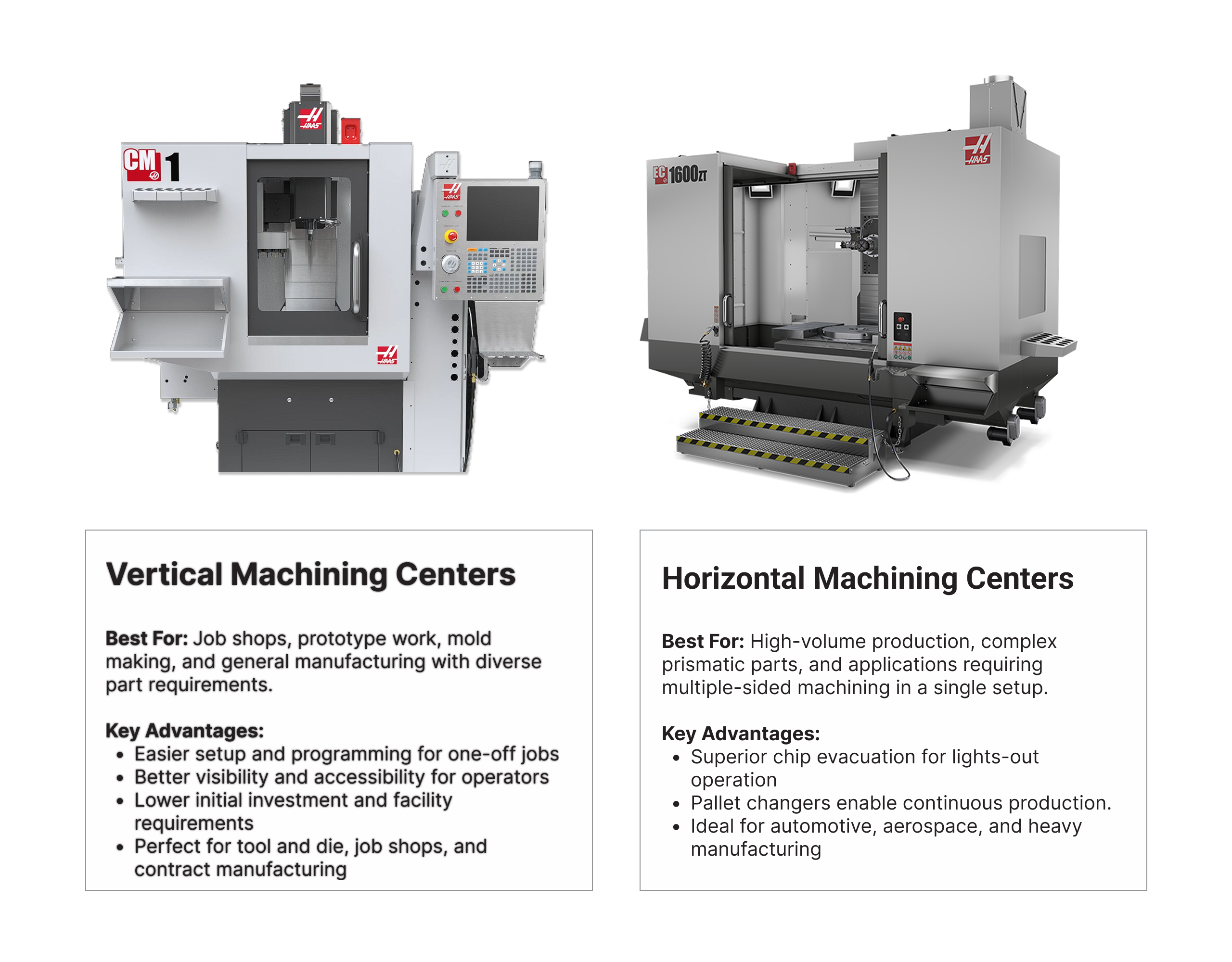
A VMC Center features a vertical spindle, making it ideal for flat or plate-type work where top access is easy. This orientation is intuitive for many operators.
An HMC Center has a horizontal spindle, which provides excellent chip evacuation. Gravity naturally pulls chips away from the cutting zone, leading to better surface finishes and reduced recutting risk, especially in deep pockets. This can significantly improve tool life and part quality.
Workholding and Setups
A VMC typically works with a flat table, often requiring multiple setups six or more operations to machine all six sides of a complex part. This means more operator handling and downtime.
Conversely, an HMC frequently features 4-axis capabilities with pallet changers and tombstone fixtures. The same six-sided part can often be completed in just two operations, and often, the spindle keeps cutting on one pallet while another part is loaded and prepared on another. This parallel processing boosts productivity.
Cost, Space, and Spindle Utilization
Cost & Space
HMC costs are generally higher up front compared to a VMC Center, and they demand more floor space. A larger, heavier machine naturally needs more room.
VMCs are more affordable, easier to maintain, and take up less space, making them suitable for smaller shops and first CNC purchases.
Spindle Utilization
Spindle utilization is a critical metric for production. VMCs often average 25–50% spindle utilization in mixed-production environments, while well-implemented HMC systems in production settings commonly reach 60–80%, with higher utilization possible in optimized lights-out operations. This vast difference stems from the HMC’s design to keep the spindle cutting almost continuously. Pallet changers and reduced part handling on HMCs minimize idle time, maximizing the machine’s actual working hours.
HMC Cost vs. VMC Cost: A Deeper Look
Understanding the true cost comparison of HMC vs VMC goes beyond the initial purchase price. While an average VMC purchase might be around $115,000 USD, an HMC can be closer to $375,000 USD. This means a VMC of similar capacity can be 40-60% less expensive initially.
Maintenance & Repair
Maintenance and repair also favor VMCs due to their simpler, more compact designs with fewer complex subsystems. Routine maintenance and repairs are typically less expensive and easier.
HMCs, with their complex pallet changers, larger rotary axes, and more axes of movement, incur higher maintenance costs and require more specialized service. Reports indicate major repairs on HMCs, like spindle rebuilds and ball screw replacements, can be several times the cost of a VMC.
Operating Costs & Labor
However, operating costs and labor tell another story. HMCs are designed for constant spindle cutting and reduced operator intervention. A cost study example suggested that an HMC’s productivity, factoring in higher spindle utilization and reduced handling, could save approximately $12,000 USD per month in labor versus a VMC in a busy production setting.
This can more than offset the extra $4,800 USD per month in finance cost for an HMC. The break-even point is crucial: if an HMC can realistically replace the output of three VMCs, its labor savings and higher utilization can quickly make it the more cost-effective choice per part. Here’s how to Calculate VMC Machine Hour Rate and Improve Your Setup.
Tooling Costs
Tooling costs are also a factor. While HMCs often justify a larger initial investment in premium carbide cutters and complex tombstone fixtures, they can lead to lower overall tooling costs per unit of output. A single HMC replacing two to three VMCs can centralize tooling; instead of buying three full sets of holders and cutters for three VMCs, you tool up one HMC more heavily.
Furthermore, superior chip evacuation and more rigid setups on HMCs often improve tool life and consistency, lowering cost per part even if each individual cutter is more expensive. For VMCs, a modest set of standard vises and general-purpose cutters keep the initial tooling budget lower.
How to Decide Which is Best for Your Shop
To make an informed decision between Horizontal Machining Centers and Vertical Machining Centers, ask yourself these questions:
- Do you primarily run short-run, varied work, or consistent, medium-to-high volume jobs?
- Are your parts mostly flat, simple 3-axis designs, or complex multi-face prismatic components?
- Is your biggest constraint a limited budget and floor space, or labor costs and maximizing spindle hours?
If you’re a smaller operation or a job shop with many different parts, frequent changeovers, limited space, and a tighter budget, a VMC Center is likely your best bet. If you run medium-to-high volume work, produce multi-face parts, and prioritize spindle utilization and output per operator, an HMC Center will deliver greater value. Consider your typical part size, materials, and batch quantities. By carefully evaluating these factors against the capabilities and cost structures of both Vertical Machining Centers and Horizontal Machining Centers, you can confidently choose the machining solution that truly benefits your business.
Have questions? We have answers!
Contact us with setup questions or subscribe to our newsletter for machining insights and CNC updates.