


Updated 2026. This article is based on an article featured in Production Machining’s January 2008 Issue
Click here to see the article.
Click here to learn more about RoboFlex.
Handling Parts in a Robotic CNC Machining Cell
Implementing a robotic cell in CNC machining operations offers clear financial and operational benefits. Automated machine tending increases spindle utilization, improves production consistency, and can reduce labor costs on a single machine by more than 90 percent. Achieving these results requires strategic planning, particularly around how workpieces enter, move through, and exit the cell. System integrators like Productivity build these automated machining cells using Fanuc robots paired with various machine tools.
Key Planning Considerations for Robotic Cells
While the robot itself gets most of the attention, successful automation depends on several supporting components.
Key elements that require careful planning include:
- Grippers and end-of-arm tooling (EOAT)
- Safety guarding and automatic door openers
- Workholding fixtures
- In-feed and out-feed material handling devices
- Vision systems
- Mechanical and electrical system integration
Keeping system design simple offers distinct advantages. Simple cells are versatile, easier to reconfigure for new parts, and deliver higher uptime. As cell complexity increases, change-over times lengthen, and managing a mixed part catalog becomes more difficult.
Moving Workpieces Through the Cell
1. In-Feed Methods
The first step in part handling is delivering raw stock to the cell. Depending on whether the material consists of raw blanks, forgings, or castings, shops use several in-feed mechanisms:
- Bar feeders: Provide continuous material directly to the spindle.
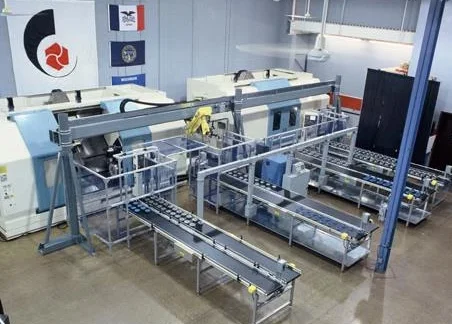
- Conveyors: Transport loose or aligned parts into the robot’s reach.
- Nested pallets, vertical stacking, or drawer units: Hold organized arrays of parts.
To locate randomly spaced parts on a conveyor, integrators often pair conveyors with 2D vision systems, such as Fanuc’s iRVision, to guide the robot to the workpiece. In simpler setups, precise part placement on a conveyor or pallet—combined with accurate robot programming—allows the robot to pick up parts reliably without cameras. Advanced 3D vision enables bin picking for complex layouts, though parts trapped in corners or foreign debris in the bin can cause pickup issues.
2. End-of-Arm Tooling and Fixtures
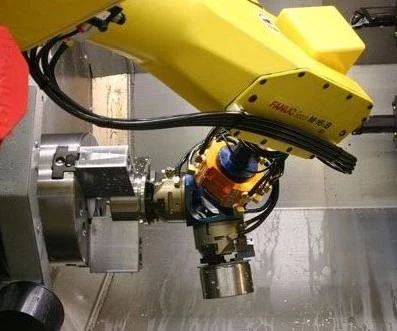
The robot’s end-of-arm tooling (EOAT) must hold the part securely. Integrators prioritize commercial off-the-shelf components, but custom fingers and fixtures are frequently required.
- Swappable fingers: Changing only the gripper fingers allows one tool body to handle different part geometries.
- Common fixtures: Standardize the pickup location so custom fingers are not required for every single part design.
- Sensors: Finger sensors verify whether grippers are open or closed, giving the system a definite signal that a part is held.
- Dual grippers: A two-headed gripper allows the robot to unload a finished workpiece and load a raw blank in a single trip into the machine, reducing cycle times.
- Integrated blowoff: Air nozzles clean chips and coolant off the workholding fixture before the next blank is placed.
3. Chip Control
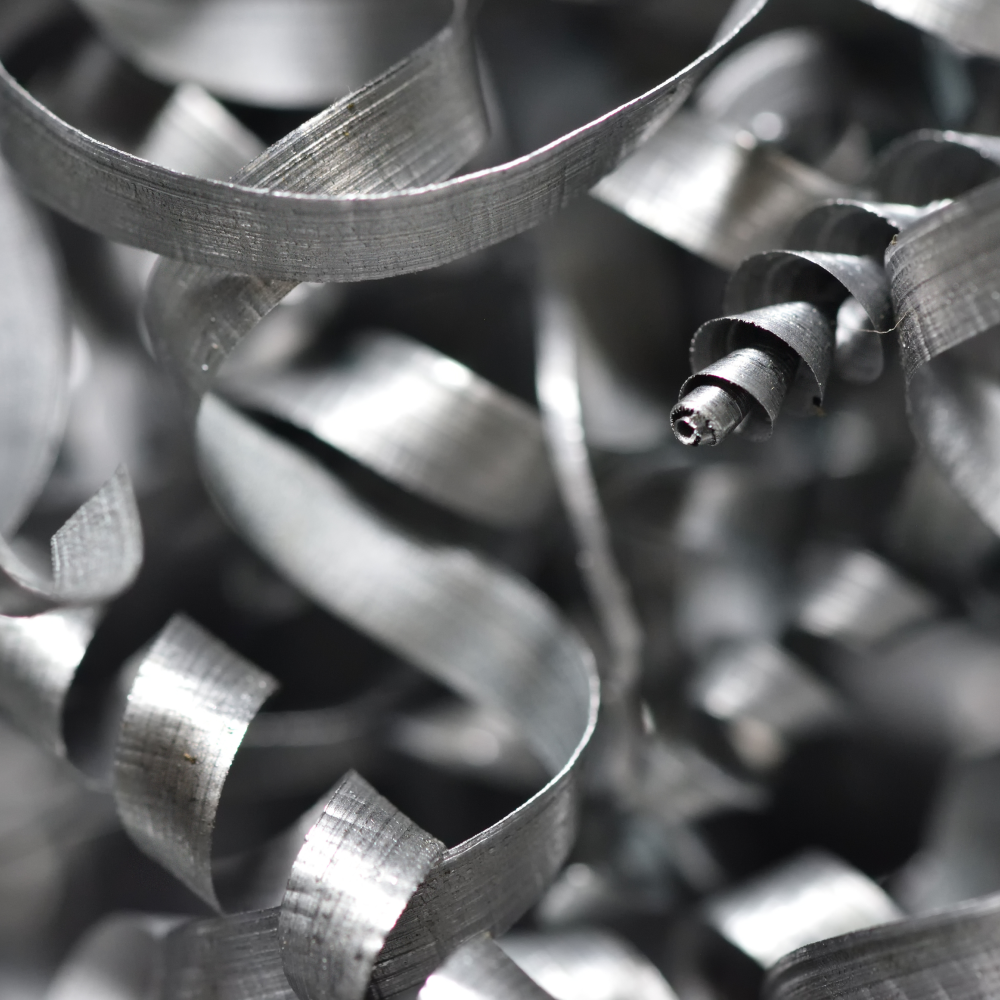
Chip control is the single most important factor in cell automation. Long, stringy chips can tangle around fixtures, grippers, and workpieces, disrupting the process. Before installing a robot, shops must refine their cutting parameters—adjusting speeds, feeds, and chipbreakers—to ensure chips break cleanly.
4. Out-Feed and Post-Processing
After machining, the robot transfers the finished workpiece to an out-feed device, such as a conveyor or palletizing station. From there, parts move to post-processing operations like cleaning, inspection, or packaging.
Conveyors remain the most common out-feed choice due to their simplicity. When paired with a vision system, a simple light beam across the conveyor acts as an end stop, holding the part in the camera’s field of view so the robot can locate and grab it.
Choosing the Right Gripper Mechanism
Robots use two-jaw, three-jaw, or specialized grippers based on the shape and material of the part:
|
Gripper Type
|
Characteristics & Operational Impact
|
|
Pneumatic Grippers
|
Greased for life; highly reliable over millions of cycles with minimal maintenance. |
|
Vacuum Grippers
|
Prone to pulling in chips, coolant, and debris, which reduces suction effectiveness over time. |
|
Magnetic Grippers
|
Can attract stray metal shavings that interfere with precise placement in machine workholding. |
The Role of the Human Operator
Automation changes the machine operator’s duties rather than eliminating them. While the cell components maintain continuous output without taking breaks, human oversight remains essential.
Operators in a robotic cell are responsible for:
- Loading raw material onto in-feed conveyors or pallets
- Unloading finished parts from out-feed stations
- Monitoring part dimensions and quality
- Managing tool wear and performing tool changes
- Clearing unexpected system faults
Proper planning across workholding, grippers, and material flow allows shops to achieve consistent production gains while making the best use of operator labor.